Sustainability Reporting Guide for Regulatory Compliance Success


Facing a maze of evolving sustainability mandates in every continent, multinational organizations risk costly missteps if their reporting foundation is shaky. Corporate sustainability managers must unite scattered data sources, clarify compliance needs, and integrate frameworks such as CSRD and SBTi. By establishing robust data governance and aligning environmental metrics with leading standards like GRI and SASB, organizations can transform compliance into a strategic advantage and protect business credibility across jurisdictions.
Table of Contents
Quick Summary
Key Point | Explanation |
1. Assess Data and Regulations First | Understand your data landscape and regulatory requirements to ensure accurate and compliant reporting. |
2. Integrate Frameworks for Efficiency | Align multiple sustainability frameworks to streamline reporting and satisfy various compliance needs cohesively. |
3. Establish Clear Data Ownership | Assign specific responsibilities for data collection to avoid inconsistencies and ensure accuracy across all metrics. |
4. Implement Rigorous Data Validation | Create a robust validation process to verify data accuracy before submission to prevent compliance issues. |
5. Prioritize High-Materiality Issues | Focus efforts on critical sustainability gaps that significantly impact business and stakeholder decisions to allocate resources effectively. |
Step 1: Assess Organizational Data and Reporting Needs
Before you can report accurately, you need a clear picture of what data exists within your organization and what regulators actually require. This step determines your reporting foundation and reveals gaps that could derail compliance efforts.
Start by mapping your current data landscape. You likely have sustainability information scattered across departments: carbon emissions tracked by facilities, water usage in manufacturing, supply chain data in procurement, and ESG metrics in human resources. The challenge is bringing these together coherently.
Create a simple inventory of what you currently measure and where it lives:
Greenhouse gas emissions across scopes 1, 2, and 3
Resource consumption (water, energy, waste)
Supply chain and vendor information
Employee diversity and labor data
Regulatory compliance records
Third-party certifications or audit reports
Next, identify your regulatory landscape. If your organization operates internationally, you face overlapping requirements. The EU Corporate Sustainability Reporting Directive applies to large companies and progressively to smaller ones. The Non-Financial Reporting Directive still governs certain organizations. Global frameworks like SBTi and TNFD add additional criteria.
Documenting your regulatory requirements prevents costly oversights:
List all jurisdictions where your company operates
Note which disclosure standards apply to your organization
Record specific metrics each framework demands
Identify reporting deadlines for each requirement
Now assess your people and processes. Effective reporting requires collaboration across finance, operations, sustainability, and communications teams. Organizations with fragmented accountability often produce inconsistent data quality. Establish clear ownership: who collects emissions data, who validates it, who reports it?
Evaluate your technology gaps honestly. Spreadsheets don’t scale when you’re tracking hundreds of data points across global operations. Consider whether your current systems can integrate data from multiple sources, automate calculations, and generate audit trails.
Strong data governance separates compliant organizations from those facing regulatory penalties. Define standards, ownership, and quality checks now rather than scrambling during audit season.
Finally, prioritize your gaps. Not every missing piece requires immediate attention. Focus on high-materiality issues first—those that significantly impact your business or stakeholder decisions. This prevents overwhelm and concentrates resources where they matter most.
Pro tip: Interview department heads before building your assessment. They’ll reveal hidden data sources and realistic timelines for collecting missing information, saving you months of wasted effort.
Step 2: Integrate Sustainability Frameworks and Compliance Standards
You’ve identified your data and regulatory landscape. Now you need to align them with globally recognized frameworks that your stakeholders actually expect. This step prevents reporting fragmentation and ensures your data serves multiple compliance requirements simultaneously.
Start by understanding the major frameworks in play. The GRI Standards are the most widely adopted globally, covering broad environmental, social, and economic impacts across all industries. SASB Standards focus narrowly on investor-material sustainability issues specific to your sector. The CSRD requires double materiality assessment for European companies. SBTi demands science-based climate commitments.
These frameworks aren’t competing choices. They overlap significantly, and smart organizations use their interoperability to report once, satisfy many requirements.
Create a framework alignment matrix to map your reporting needs:
List each applicable framework in columns
List your material sustainability topics in rows
Identify which framework addresses each topic
Note overlapping requirements to avoid duplicate metrics
Next, determine your primary framework. For most multinational organizations in sustainable growth mode, GRI Standards provide the foundation because they cover both financial and non-financial impacts comprehensively. Then layer industry-specific requirements like SASB on top.
Align your materiality assessment across frameworks. GRI requires impact materiality (how your organization affects stakeholders and the environment). CSRD requires financial materiality (how sustainability issues affect your business performance). Double materiality means assessing both directions. Don’t conduct separate materiality processes; integrate them into a single analysis that satisfies all requirements.
Here’s a quick comparison of leading sustainability reporting frameworks highlighting their focus and key requirements:
Framework | Main Focus | Materiality Approach | Common Compliance Requirement |
GRI Standards | Broad ESG impacts | Impact materiality | Comprehensive disclosures |
SASB Standards | Industry-specific metrics | Financial materiality | Sector-focused KPIs |
CSRD | Double materiality | Both financial & impact | Mandatory EU reporting |
SBTi | Science-based climate goals | Impact-based targets | Emissions reduction commitment |
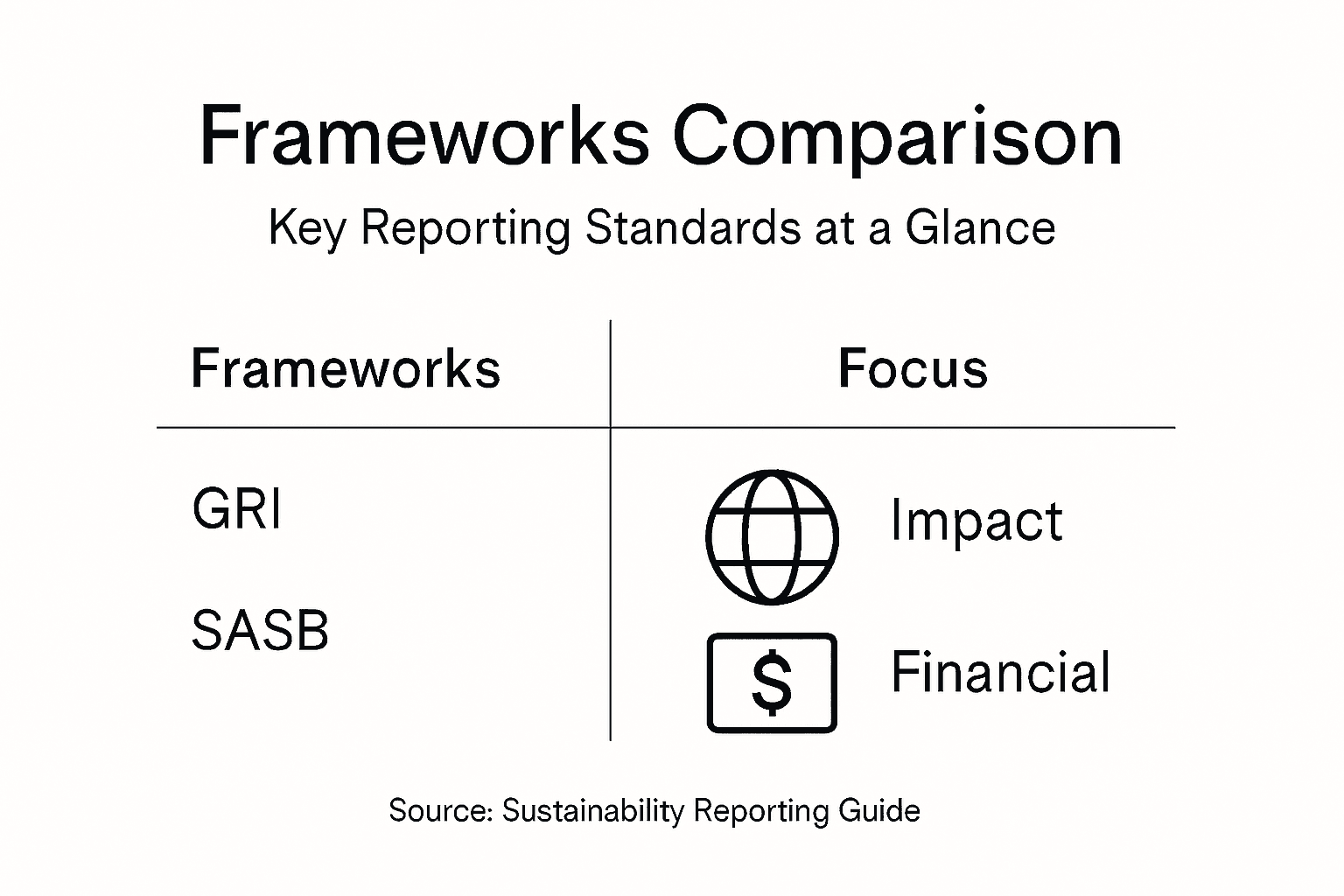
This summary illustrates the distinct roles each framework plays and why combining them improves reporting coverage.
Identify critical overlaps that let you consolidate metrics. Many frameworks ask for greenhouse gas emissions, energy consumption, and diversity data using similar methodologies. Standardize your measurement approach to feed one data source into multiple reporting outputs.
Organizations reporting under multiple frameworks waste resources when they treat each one separately. Framework integration transforms compliance from a burden into a strategic efficiency gain.
Determine your reporting timeline by framework. CSRD deadlines differ from SBTi validation windows. Create a master calendar that prevents bottlenecks and allows enough time for quality assurance before each deadline.
Pro tip: Choose one trusted framework to guide your internal data governance, then map other frameworks to it using published alignment guides. This reduces complexity and ensures consistency across all your compliance reporting.
Step 3: Collect and Analyze Environmental Impact Data
You’ve mapped your frameworks and compliance requirements. Now comes the practical work: gathering actual environmental data from your operations and analyzing it rigorously. This step transforms theoretical commitments into measurable, auditable results.

Start by establishing clear data ownership across your organization. Weak data protocols create gaps where nobody knows who measures what, how often, or what methods they use. Assign specific teams responsibility for each data category: emissions from facilities, energy from procurement, water from operations, supply chain data from vendor management.
Define your data collection methodology before you begin gathering information. Different facilities may calculate greenhouse gas emissions differently, leading to incomparable results. Specify which calculation standards you’ll use (GHG Protocol, ISO 14064), which emission factors apply, and acceptable measurement frequencies.
Here’s what robust data collection requires:
Identify all data sources (meters, invoices, third-party databases, supplier reports)
Establish collection frequency aligned with your reporting deadlines
Implement documented procedures so anyone can follow them consistently
Create quality checkpoints to catch errors early
Assign clear accountability for each data source
When calculating your corporate carbon footprint, you’ll need emissions across scopes 1, 2, and 3. Scope 3 (supply chain emissions) often represents 70 percent or more of your total impact but remains the hardest to measure accurately. Start with your highest-impact suppliers and work systematically outward.
For water and other environmental metrics, similar rigor applies. Use consistent methodologies across all facilities so you can aggregate results reliably. Understanding your water footprint helps identify where conservation efforts matter most.
Analyze your data for patterns and outliers. A facility consuming 50 percent more water than similar operations deserves investigation. Maybe a leak exists. Maybe the facility runs inefficient processes. Maybe your calculation method differs. Whatever the cause, analysis reveals opportunities for improvement.
Poor data collection creates compliance risk, not just reporting difficulty. Regulators increasingly scrutinize sustainability claims backed by weak data infrastructure.
Document your methodology, assumptions, and quality controls in a data inventory that auditors can review. This transparency builds credibility with stakeholders and regulators.
Pro tip: Implement data collection systems before your reporting deadline arrives. Organizations scrambling to gather data weeks before submission often miss sources entirely or use inconsistent methodologies that require expensive restatements.
Step 4: Compile Reports and Validate Accuracy as in Sustainability Reporting Guide
You’ve collected your data methodically. Now you need to organize it into coherent reports and verify that everything is accurate before submission. This step separates credible disclosures from those that invite regulatory scrutiny.
Start by organizing your data systematically. Different frameworks require different structures, but all demand clarity about sources, assumptions, and calculation methods. Create a master spreadsheet or database that maps each metric to its source data, the person responsible for collecting it, and the date of last update.
Build your report structure around your primary framework first, then layer additional requirements on top. If you’re using GRI Standards, follow their recommended disclosure structure. If CSRD applies, ensure you address double materiality assessment upfront. Your report should tell a coherent story about your environmental performance, not read like disconnected data points.
Implement a validation process before finalizing anything. Poor validation creates expensive problems later.
Your validation checklist should include:
Verify data completeness against your scope (all facilities, all metrics, all time periods)
Reconcile current year data with prior year to catch inconsistencies
Cross-check calculations against source documents
Confirm all assumptions remain reasonable and documented
Test that aggregated numbers match their component parts
Engage cross-functional review teams. Finance should validate emissions calculations. Operations should confirm facility-level data accuracy. Sustainability should check framework alignment. This multi-perspective approach catches errors that single-function review misses.
Use quality assurance and continuous improvement mechanisms embedded in your reporting process. Document what you checked, who verified it, and when. This audit trail becomes invaluable when regulators request proof of your validation efforts.
The following table summarizes actions for effective data governance and business benefits:
Action Step | Responsible Team | Business Impact |
Assign clear data ownership | Operations & Finance | Reduces reporting errors |
Standardize data collection methods | Sustainability | Enables comparability |
Map data to regulatory standards | Compliance | Avoids costly penalties |
Implement automated audits | IT & Sustainability | Accelerates validation process |
By following these steps, organizations ensure compliant, reliable sustainability reporting.
Create an error log tracking issues found and how they were resolved. Pattern analysis reveals systematic problems: maybe one facility consistently misreports water usage, or your scope 3 estimation methodology needs refinement. These patterns guide improvements in your next reporting cycle.
Implement automated validation rules in your reporting system where possible. Flagging when a metric falls outside historical ranges catches data entry errors immediately rather than during final review.
Validation isn’t a box-checking exercise. It’s your organization’s credibility shield against both unintentional errors and accusations of misrepresentation.
Document your validation conclusion formally. If your report has limitations, acknowledge them transparently rather than hoping nobody notices. Regulators appreciate honesty about data quality challenges more than they appreciate unrealistic claims of perfection.
Pro tip: Build at least two weeks into your reporting timeline for validation activities. Rushed validation invariably misses errors, leading to embarrassing corrections, reputational damage, and potential regulatory penalties.
Empower Your Sustainability Reporting with Carbonze
Struggling with fragmented data collection and complex regulatory demands outlined in the Sustainability Reporting Guide for Regulatory Compliance Success Understand how to overcome challenges like aligning multiple frameworks, ensuring data accuracy, and meeting stringent deadlines with a platform designed to streamline these exact pain points Carbonze integrates comprehensive tools for managing your GHG Emissions alongside water, land, and biodiversity impacts while staying aligned with key Climate Policies such as CSRD and SBTi.
Take control of your environmental data with Carbonze’s advanced dashboards, automated quality checks, and collaborative features that reduce the risk of errors and regulatory penalties Act now to transform regulatory complexity into a strategic advantage Visit Carbonze today and start your seamless journey toward compliant and credible sustainability reporting.
Frequently Asked Questions
How do I assess my organization’s data and reporting needs for sustainability?
Start by mapping out the current data landscape within your organization. Inventory existing data sources such as greenhouse gas emissions, resource consumption, and regulatory compliance records to identify gaps that may impact compliance.
What frameworks should I integrate into my sustainability reporting?
Focus on the major frameworks like the GRI Standards, SASB Standards, and CSRD. Create a framework alignment matrix to map metrics to each framework and reduce duplication when reporting.
How do I ensure the accuracy of my environmental impact data collection?
Establish clear data ownership by assigning specific teams responsibility for various data categories. Document your data collection methodology and regular quality checks to maintain accuracy.
What steps should I follow to compile and validate my sustainability report?
Organize your data systematically by creating a master spreadsheet that links metrics to their sources. Implement a validation process involving cross-functional teams to catch any errors before submission.
How can I prioritize the gaps identified in my sustainability data assessment?
Focus on addressing high-materiality issues first, as they significantly impact your business or stakeholder decisions. This approach helps concentrate resources effectively and prevent you from feeling overwhelmed.
Recommended


Comments