Environmental Stewardship: Creating Value Beyond Compliance


Pressure to deliver authentic environmental outcomes now sits at the top of the agenda for global businesses. For corporate sustainability managers, the shift from simple compliance to true environmental stewardship means more than just meeting regulations—it is about building long-term value and staying competitive in every region of operation. This article breaks down the practical meaning of stewardship in business, illuminating the types of actions and principles that drive real impact across global supply chains.
Table of Contents
Key Takeaways
Point | Details |
Environmental Stewardship vs. Compliance | Environmental stewardship goes beyond legal compliance, fostering proactive engagement for long-term value creation and competitive advantage. |
Core Stewardship Types | Organizations should identify and implement stewardship actions tailored to their specific environmental impacts and stakeholder expectations. |
Innovation through Stewardship | Embedding environmental responsibility into strategy drives innovation, reduces operational costs, and builds resilience against regulatory changes. |
Stakeholder Engagement is Crucial | Involve all stakeholders—employees, suppliers, and communities—in stewardship efforts to enhance participation, accountability, and effectiveness. |
Defining Environmental Stewardship in Business
Environmental stewardship in business goes far beyond checking compliance boxes. It’s about embedding responsibility into how your organization operates, makes decisions, and creates long-term value. For corporate sustainability managers, this distinction matters—compliance keeps you legal; stewardship creates competitive advantage.
At its core, environmental stewardship involves protecting, restoring, and sustainably using natural resources for lasting benefit to both environment and society. But in a business context, stewardship also means recognizing that your organization sits within interconnected ecosystems and supply chains. Your decisions ripple outward.
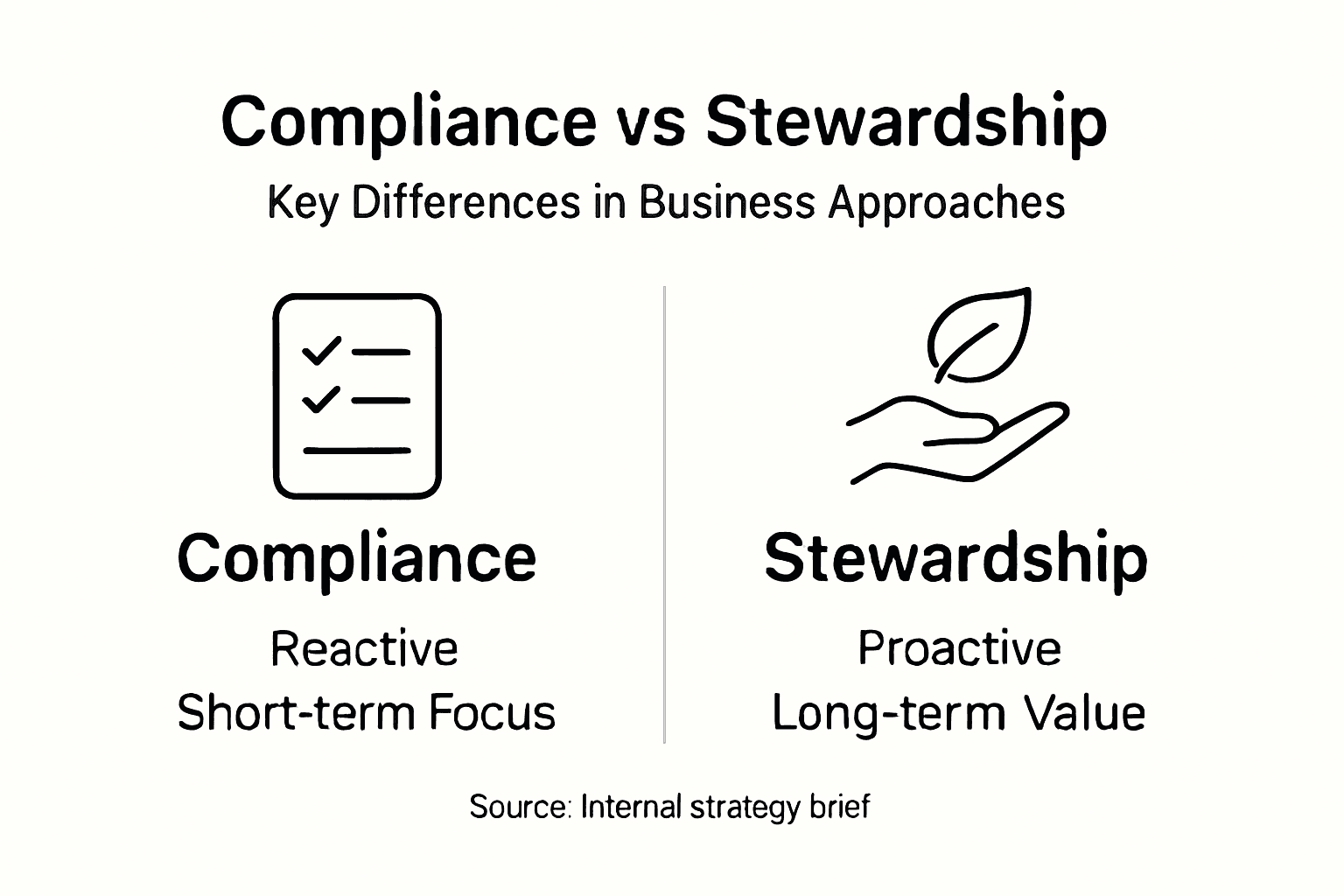
Think of it this way: compliance is reactive. You measure emissions because regulations require it. Stewardship is proactive. You reduce emissions because you’re committed to resource efficiency and ecosystem resilience—and because that commitment strengthens your brand, reduces operational costs, and attracts talent.
Here’s a comparison of compliance and stewardship in business:
Aspect | Compliance Approach | Stewardship Approach |
Mindset | Meets legal minimums | Exceeds baseline voluntarily |
Motivation | Risk avoidance | Long-term value creation |
Measurement | Tracks required metrics | Assesses full value chain impact |
Stakeholder View | Focus on authorities | Engages communities, investors, staff |
Brand Impact | Neutral or limited | Positive differentiation and trust |
Adaptability | Reacts to change | Anticipates and leads change |
What Stewardship Actually Looks Like
Environmental stewardship in business encompasses several interconnected dimensions:
Biodiversity and ecosystem protection across operations, supply chains, and communities where you operate
Water management that goes beyond discharge limits to understand your true water footprint and freshwater impact
Carbon accountability integrated into strategic planning, not siloed in sustainability departments
Transparent reporting that shows stakeholders real progress, not greenwashing narratives
Active engagement with suppliers, partners, and communities on shared environmental goals
For multinational firms, stewardship also means aligning operations across geographies. Environmental impacts in one region affect your global reputation and risk profile.
Why This Matters for Your Organization
Here’s the critical insight: companies practicing genuine environmental stewardship outperform those treating sustainability as compliance theater. They see reduced operational costs, attract mission-driven talent, and maintain stakeholder trust when regulations inevitably tighten.
Environmental stewardship transforms sustainability from a compliance cost center into a strategic business function that drives innovation, resilience, and long-term value creation.
Your competitors are still asking “What do we have to do?” Stewardship-focused organizations ask “What should we do, and how do we measure real impact?” That mindset shift unlocks competitive positioning.
The business case is clear: organizations integrating stewardship into core strategy build stronger stakeholder relationships, reduce regulatory risk, and create sustainable competitive advantages that last through market cycles.
Pro tip: _Start by mapping your organization’s most material environmental impacts—carbon, water, biodiversity, and waste—across your full value chain. Stewardship begins with honest measurement, not aspirational targets.
Types and Key Principles of Environmental Stewardship
Environmental stewardship isn’t one-size-fits-all. Different organizations pursue stewardship through distinct approaches, each addressing specific environmental challenges and business contexts. Understanding these types helps you build a stewardship strategy aligned with your company’s operations and stakeholder expectations.
Five Core Types of Stewardship Actions
Effective stewardship operates across five interconnected action categories that work together to drive real environmental outcomes:
Restoration and protection involves actively recovering degraded ecosystems and safeguarding intact ones. For multinational firms, this might mean wetland restoration near manufacturing sites or protecting biodiversity corridors across supply chain regions.
Sustainable resource use means extracting and consuming resources—water, timber, minerals—in ways that maintain ecosystem health. This is where operational efficiency directly connects to environmental responsibility.
Education and outreach builds internal and external awareness. Your employees become stewardship ambassadors when they understand why resource reduction matters beyond compliance.
Policy and advocacy shapes industry standards and regulatory environments. Industry leadership means advocating for standards that level the playing field and prevent greenwashing competitors.
Monitoring and evaluation tracks actual progress against commitments. This is where transparency happens. You measure what matters, not just what’s easy to measure.
The Principles That Make Stewardship Work
Behind effective stewardship sit three foundational principles:
Responsibility and accountability mean your organization owns environmental impacts across your value chain, not just at the factory gate. You measure scope 1, 2, and 3 emissions because responsibility is comprehensive.
Ecosystem resilience focuses stewardship on long-term health, not short-term extraction. Resilient ecosystems buffer against climate volatility and supply chain disruption—direct business benefits.
Collaboration across scales recognizes that environmental challenges cross organizational boundaries. Your stewardship requires supplier engagement, community partnerships, and industry coordination.
Stewardship principles guide how you act, not just what you measure. They transform your sustainability approach from a checklist into a systematic practice.
Why These Types Matter for Your Organization
Different business models emphasize different stewardship types. A consumer goods company might prioritize sustainable resource use and education. An extractive industry leader focuses on restoration and monitoring. Water-intensive operations center on resource use and ecosystem resilience.
The point: stewardship isn’t generic. You select and sequence action types based on your material environmental impacts and stakeholder priorities.
Pro tip: Map your organization’s stewardship strategy across all five action types, ensuring each material environmental impact has dedicated stewardship actions with assigned accountability and measurable targets.
This summary shows how five stewardship actions typically align with different business models:
Stewardship Action | Best Fit Sector | Main Business Benefit |
Restoration & Protection | Extractives, Manufacturing | Rebuilds ecosystems, mitigates risk |
Sustainable Resource Use | Fast-moving consumer goods | Lowers costs, supports efficiency |
Education & Outreach | All sectors | Builds internal culture, reputation |
Policy & Advocacy | Industry leaders | Influences regulation, levels field |
Monitoring & Evaluation | Multinationals, supply chain intensive | Ensures accountability, enhances reporting |
How Stewardship Drives Innovation and Value Creation
Stewardship isn’t a drag on profitability. It’s the opposite. Companies embedding environmental responsibility into strategy unlock innovation, attract talent, and build resilience that competitors scrambling to meet minimum compliance can’t match.

Here’s the mechanism: when you commit to long-term environmental stewardship, you stop optimizing for quarterly results. You start asking different questions. How do we reduce water consumption by 40% without sacrificing output? What materials exist that eliminate toxic discharge? How do we partner with suppliers to drive shared value?
Those constraints breed innovation.
The Innovation Connection
Stewardship drives innovation by encouraging long-term thinking beyond short-term profits, forcing organizations to invest in sustainable technologies and processes. Companies practicing stewardship strengthen competitiveness through systematic resource optimization and talent development.
Consider what happens operationally:
Resource efficiency improvements cut costs while reducing environmental impact. Water recycling systems, waste-to-energy programs, and circular supply chains generate dual wins.
Technology investments in emissions tracking, renewable energy, and clean production become strategic priorities, not afterthoughts. This positions your firm ahead of regulatory changes.
Supply chain transformation drives supplier innovation. You’re not just auditing compliance—you’re catalyzing partners to rethink their processes alongside you.
Employee attraction and retention improves when your workforce sees the company walking the stewardship talk. Purpose-driven employees innovate harder.
Building Value Across Generations
Stewardship flips the value creation timeline. Instead of extracting maximum profit today and externalizing environmental costs to future generations, stewardship companies build intergenerational value.
This attracts patient capital—investors and lenders willing to accept lower short-term returns for lower long-term risk. Patient capital funds innovation that transforms industries.
Your financial resilience improves too. Companies managing water scarcity, carbon pricing, and supply chain disruption outperform peers caught flat-footed by tightening regulations.
Stewardship-driven companies don’t just comply with tomorrow’s regulations—they shape them, gaining first-mover advantage in emerging markets while competitors play catch-up.
Different Stewardship Styles Drive Different Value
Not every organization innovates identically. Some firms act as Unlockers, removing barriers for others to innovate. Others function as Enablers, providing resources and platforms. Catalyzers spark systemic change through collaboration.
Your stewardship style depends on your position in the value chain and industry influence. A multinational manufacturer might unlock supplier innovation. An industry association might catalyze sector-wide standard-setting.
The point: stewardship creates competitive moats through differentiation, cost advantage, and stakeholder loyalty that compliance-only competitors can’t replicate.
Pro tip: Identify 2-3 material environmental challenges in your operations, map them to potential innovation opportunities, and assign cross-functional teams to develop stewardship-driven solutions that reduce impact while improving efficiency or revenue.
Legal, Regulatory, and Reporting Obligations Worldwide
Compliance isn’t optional anymore. Governments worldwide are tightening environmental stewardship requirements through binding legal frameworks that directly impact your operations, supply chains, and financial reporting. Understanding these obligations—and preparing for them—separates leaders from laggards.
The regulatory landscape has shifted fundamentally. What started as voluntary sustainability initiatives has evolved into mandatory disclosure, emissions accounting, and environmental impact assessments with real legal teeth. Your organization faces overlapping obligations depending on where you operate, your industry, and your size.
Global Regulatory Framework
Environmental stewardship is closely linked to environmental law and governance frameworks worldwide, with robust legal mechanisms essential for achieving sustainability goals. International treaties, multilateral environmental agreements, and national laws set binding obligations across jurisdictions.
Key regulatory categories include:
Climate reporting standards requiring transparent disclosure of greenhouse gas emissions, climate risks, and transition plans aligned with Paris Agreement commitments
Water and biodiversity regulations mandating environmental impact assessments, ecosystem protection, and restoration obligations
Sustainability disclosure requirements such as the EU Corporate Sustainability Reporting Directive that demand standardized reporting on environmental, social, and governance metrics
Supply chain accountability laws holding companies responsible for environmental violations by suppliers and partners
Circular economy mandates requiring extended producer responsibility and waste reduction targets
The Environmental Rule of Law
The environmental rule of law integrates environmental needs with legal rights and obligations, ensuring compliance and enforcement of standards across jurisdictions. This framework promotes transparency and addresses climate change and biodiversity challenges.
For multinational firms, this means operating under multiple legal regimes simultaneously. Your European operations follow different standards than your Asian facilities. Your North American supply chain faces distinct regulations from your Australian operations.
This complexity creates operational risk—and opportunity. Organizations building integrated compliance systems gain competitive advantage as regulations converge toward consistent global standards.
Legal obligations are tightening worldwide. Companies treating compliance as a checkbox are building fragile strategies. Those embedding legal requirements into operational design build sustainable competitive advantage.
Practical Compliance Strategy
Ignoring jurisdictional differences isn’t viable. You need systematic approaches:
Map your material environmental impacts across all operating geographies
Identify applicable regulations in each jurisdiction and assess compliance gaps
Integrate reporting systems that capture data aligned with multiple standards simultaneously
Build supply chain transparency mechanisms that extend accountability upstream
Establish governance structures with clear accountability for compliance and stewardship
Regulatory requirements continue accelerating. Organizations responding proactively position themselves ahead of enforcement actions and competitive disadvantage.
Pro tip: Conduct a regulatory compliance audit across all your operating jurisdictions, documenting which environmental laws apply to your operations, and identify which reporting frameworks align with multiple regulatory requirements to reduce redundancy.
Common Pitfalls and Best Practices for Implementation
Most organizations fail at environmental stewardship not because they lack good intentions, but because they skip critical foundational steps. They measure the wrong metrics, silence stakeholder voices, and abandon initiatives when quarterly results dip. Understanding common pitfalls separates successful implementations from expensive failures.
The difference between stewardship that sticks and stewardship that collapses comes down to methodology. You need systems, accountability, and honest assessment of what’s working and what isn’t.
Common Implementation Pitfalls
Organizations typically stumble in predictable ways:
Insufficient evaluation of whether stewardship initiatives actually drive participation and environmental outcomes. You implement a water reduction program, but never measure if employees engage or if actual consumption drops.
Inconsistent adoption across your organization. Headquarters embraces stewardship principles while regional operations ignore them. Different divisions measure different metrics. Suppliers operate independently from your standards.
Limited stakeholder engagement beyond compliance-focused audiences. You exclude employees, suppliers, and communities from stewardship design, missing insights that shape successful implementation.
One-size-fits-all approaches that ignore cultural contexts and local environmental conditions. A biodiversity program designed for European operations fails in Southeast Asian contexts without adaptation.
Best Practices for Effective Implementation
Best practices suggest comprehensive understanding of stewardship, engagement of all stakeholders, and tailored interventions considering social and ecological contexts. Ongoing measurement and adaptation separate successful programs from those that stagnate.
Implementation excellence requires:
Stakeholder collaboration across departments, supply chains, and communities. Involve procurement, operations, R&D, and external partners in stewardship design from the start.
Baseline measurement and ongoing evaluation to assess whether initiatives drive real change. Define success metrics before launch, track progress monthly, and adapt based on evidence.
Integration into project planning from inception, not as an afterthought. Embed environmental stewardship into capital allocation, product development, and facility design decisions.
Life-cycle assessment across full environmental footprint—not just emissions. Account for water, biodiversity, waste, and supply chain impacts throughout operations.
Cultural competency in stewardship approaches. Understand local values, regulatory contexts, and environmental conditions in each geography where you operate.
Effective stewardship isn’t built through compliance audits or annual reporting cycles. It emerges from systematic measurement, honest accountability, and willingness to adapt when evidence shows your approach isn’t working.
Building Sustainable Momentum
Stewardship initiatives fail when organizations lose focus after initial enthusiasm fades. You need governance structures that maintain accountability, resources allocated specifically for stewardship work, and leadership that visibly prioritizes environmental outcomes alongside financial results.
Document what works. Share learning across your organization. Celebrate wins publicly. When initiatives underperform, diagnose why and course-correct rather than abandoning stewardship.
Pro tip: Establish a cross-functional stewardship committee with representatives from operations, finance, supply chain, and sustainability, meeting monthly to review progress against targets, troubleshoot implementation challenges, and identify opportunities for integration across business functions.
Unlock True Environmental Stewardship with Carbonze
Many organizations struggle to move beyond simple compliance and build genuine environmental stewardship that drives real impact and long-term value. The challenge lies in managing complex footprints across carbon, water, biodiversity, and supply chains while meeting evolving regulatory demands like the CSRD and Paris Agreement. If you want to transform sustainability from a cost center into a strategic advantage and embed responsibility deeply into your operations, you need tools that make measurement, transparency, and collaboration simple and actionable.
Carbonze Capabilities help businesses just like yours integrate stewardship principles across every function. From advanced carbon accounting aligned with global frameworks to nature impact assessment and ESG reporting that streamlines compliance, Carbonze empowers you to map your environmental impacts honestly and engage your entire value chain effectively.
Take the next step toward leadership in environmental stewardship today. Discover how Carbonze’s comprehensive platform can simplify compliance challenges while unlocking innovation and stakeholder trust. Visit Carbonze now to explore our solutions and learn more about the evolving Climate Policies shaping sustainable business. Your journey beyond compliance starts here.
Frequently Asked Questions
What is environmental stewardship in business?
Environmental stewardship in business refers to the proactive approach of protecting, restoring, and sustainably using natural resources to create long-term value for both the environment and society. It involves integrating responsibility into organizational operations and decision-making rather than merely meeting compliance requirements.
How does environmental stewardship create value for organizations?
Companies that practice environmental stewardship can reduce operational costs, enhance brand reputation, attract mission-driven talent, and build stronger stakeholder relationships, outperforming those that treat sustainability merely as a compliance requirement.
What are the key principles of effective environmental stewardship?
The key principles of effective environmental stewardship include responsibility and accountability across the value chain, a focus on ecosystem resilience for long-term health, and collaboration across various stakeholders to address environmental challenges collectively.
What are common pitfalls organizations face when implementing environmental stewardship?
Common pitfalls include insufficient evaluation of initiatives, inconsistent adoption across divisions, limited stakeholder engagement, and one-size-fits-all approaches that do not consider local environmental conditions. To succeed, organizations should foster collaboration, conduct baseline measurements, and adapt strategies accordingly.
Recommended


Comments